 |
 |
|
 |
|
|
Among the artists of Hódmezővásárhely, it is József Fodor who is connected with the highest number of ties to his home town. He was born here on December 9th, 1935. He lives and works here without interruption. Besides of his artistic work he is also active in the civil life of the town. In his oeuvre the paintings decpicting the culturally important persons and events of the town comprise a prominent position. Searching for the fountainhead of his oeuvre, the road from being a Hódmezővásárhelyian leads almost naturally into the realism of the Alföld. This statement is valid primarily in case of his artistic behavior and ethic. Because of his humanism, he depicts the humand beings and addresses his works also to them. In accordance with this, his artistic world comprises the intimate as well as the overall environment of the human beings. It is also the source of his love for the land. He is not unconcerned toward the world, the environment which he encounters on a daily basis, the environment which changes in accord with the daily, or yearly metamorphosis of nature. While discussing his relation with nature we have to give emphasis to Mártély, this small village near Hódmezővásárhely, where he has been in and out a good deal because he had a house there. The Artists' Guesthouse of Mártély also gives him daily work even today.
| 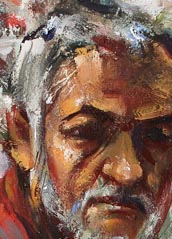 |
The backwater of the Tisza river, the trees and glades along the backwater, as well as the human built landscapes all appear on his paintings. The farmlands and the wide open plains around Vásárhely inspire him too. He does not cage in himself into his belived world which would seem to be too small to any other person. The beautiful mountain of Tokaj, or the mountainous landscapes of the Balkan, and Crete also inspired him, and moved his brushes. His oeuvre might be placed in the local Hall of Fame between the passionate, forceful dynamism, and highly contasted colorism of János Tornyai and the harmonic, calm, shady, and intimately detailed paintings of Béla Endre. His forms and contours are definite, drawn with perfection, while refer to the determinism of world in the sense of the philosophy of art. His colors are dramatic, with individually characteristic white reflexes. We should call his art as meditative realism.
He likes to share his experiences with the art loving audiences in one-man shows, as well as in group exhibitions. He won awards and prizes at home and abroad. He was awarded with the Tornyai plaque, the most prominent art prize of his town, and he got a Pro Urbe Award for his civil works. We should detail his artistic and civil works now. First, he was one of the founders of the Fine-Art Free School of Mártély, and he served as its leader for more than three decades. During the 1960s, he participated in the Tokaj Fine-Art Camp for art teachers with Zoltán Füstös. They procreated the idea of founding a similar fine-art school in Mártély, which had ideal scenery and artistic tradition for such a purpose. This ides was followd by an act, and from 1967 on, the Fine-Art Free School of Mártély was supported by the KISZ (Communist Youths Organization), the following the political changes of 1990, the Free School was - and still it is - supported by the City Council of Hódmezővásárhely. Although the Free School does not aim the training of professional artists, several prominent artists of contemporary Hungarian art started its career here, like Tamás Szabó, György Kollár, István Neuberger, László Lonovics, and others. His other important contribution of the cultural life of the town is the running of the two Artists' Guesthouses around. One of the in the Virág street at Hódmezővásárhely, while the other in Mártély. This artists from all over Hungary come here, and through them the town might be connected to the artistic life of Hungary. On the other hand those artists who come here to work in town might become followers of the Vásárhely Workshop. Finally, he was the founding father for the Ceramic Symposium, the Painters' Symposium, and the Photographers' Symposium in town. While running these important artistic workshops he got prominent, conscientious help from his wife, Zsuzsa. It is a natural consequence of his relationship with the homeland and its inhabitants the he was not impassice toward his wider community, the homeland, and its past and history. His works depicting historic events lack pathetic details, and formality. He talks about the completeness while depicting details, and inner meaning of historic events are expressed by symbolism.
|
The oeuvre of József Fodor stems from a smaller-wider environment, from the traditions of Hódmezővásárhely, and the Hungarian Great Plains. He depicts the natural, constructed, and the human universe of these. His works are in accord with the recent European cultural trend: regionalism. However, independently from this European cultural reference, he deserves the honor and acknowledgement of that community which he serves with his individual way of seeing and representing.
| 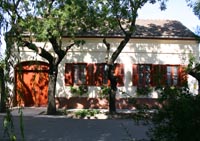
József Fodor's house |
Dr. János Dömötör
art historian
Biographical Data
Awards and Prizes
|
|
|
 |
|
 |
|
|
|